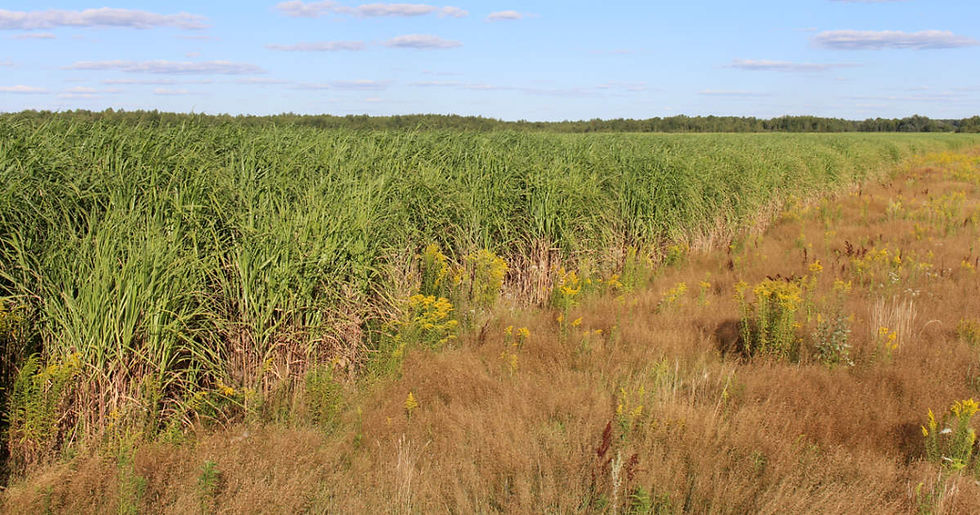
What Is Miscanthus and How Terravesta Athena Differs From Wild Type
After reading this, you'll understand why miscanthus, which has grown across Eurasia for thousands of years, and the variety planted on fields in Ukraine, are different plants. The difference explains why some rhizomes give a commercial harvest in the second year, while others may fail to establish at all.
Miscanthus is a perennial grass grown for its stems, used as fuel, building material, or an ornamental crop, depending on the species. The wild type grows across Eurasia with no documentation of origin. Terravesta Athena is not a wild variant, but a bred and patented variety of giganteus miscanthus with proven yield, drought tolerance and documented origin. This is the variety planted on fields in Ukraine.
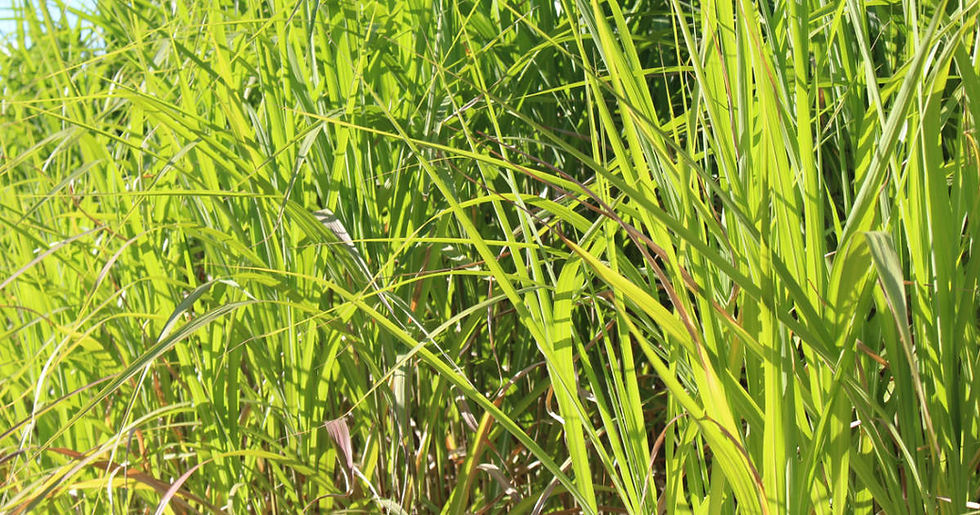
How the Wild Giganteus Differs From the Terravesta Athena Variety
Miscanthus giganteus (Miscanthus × giganteus) itself is a sterile hybrid of two Asian species, a perennial grass with C4 photosynthesis that accumulates dry matter 40% more efficiently than ordinary plants. This is the biological foundation shared by every variant of giganteus.
Terravesta Athena is the first commercially available high yielding hybrid within this species. The variety went through years of selective breeding for stable yield, drought tolerance and adaptability to different soils, something the wild giganteus lacks.
What Breeding Actually Changed
Breeding the variety delivered five measurable advantages.
• higher yield compared to standard giganteus;
• an earlier first commercial harvest;
• hardier plants, more resistant to drought;
• higher calorific value of the biomass;
• lower ash content, meaning less boiler maintenance.
One more measured trait concerns carbon. The above ground biomass absorbs roughly 26 t CO₂ eq per hectare a year, the underground rhizome adds another 3.05 t/ha, while field operations and delivery add 0.7 t/ha of emissions. Net accumulation works out to about 2.35 t CO₂ eq per hectare a year, which by Terravesta's own definition makes the crop carbon negative.
Yield, and Why the Numbers Differ
In European field trials, Terravesta Athena yields on average 30% more dry matter than standard giganteus, and in Britain's mild maritime climate that figure reaches 50%. A commercial harvest there comes a year earlier than standard miscanthus, already in year two. These results were independently confirmed by a peer reviewed paper, Awty-Carroll et al., in GCB Bioenergy (2022).
The numbers on fields in Ukraine are different, and comparing them directly with the British ones isn't accurate, since the climate, soil, and the timeline to full capacity all differ here. Here the plantation stabilises at around 15 t/ha of dry matter from the fourth year, with the first year giving around 8 t/ha.
Why Terravesta Athena Stays Within Its Plot
The variety's seed isn't viable, and that's exactly what keeps the rhizome in place. Over more than a decade of observation it spreads to a maximum of roughly one square metre and stops there. Claims that miscanthus “spreads like a weed” refer to an entirely different species, Miscanthus sinensis, an ornamental plant unsuitable for industrial biomass.
Where the Rhizomes Come From
The rhizomes planted in Ukraine come from Miscanthus Tech's own mother plantation, established in partnership with Terravesta (UK), the variety's rights holder. Every batch is traceable to this plantation rather than bought from third parties.
The variety's rights holder itself maintains constant rotation of its own European nurseries and does not sell rhizomes older than three years into their propagation cycle, which confirms the quality of the genetics behind the variety.
On fields in Ukraine, planting density runs 20,000 to 22,000 rhizomes per hectare, with the exact figure set by an audit of the specific plot covering soil, rainfall and terrain.
The variety is officially confirmed by two separate documents, registration certificate No. 24553001 and patent No. 250152, which verify this specific variety rather than planting material of unknown origin. Field performance is confirmed by a community of practising agronomists and candidates of agricultural sciences with international experience, who support the plantations throughout the season.
Frequently Asked Questions
How does Terravesta Athena differ from ordinary giganteus miscanthus?
Through breeding for yield, drought tolerance and calorific value, and through two documents that confirm the variety. Wild giganteus has none of this.
Can the Terravesta Athena variety be grown from seed?
No. The variety's seed isn't viable, so it propagates only by rhizome.
How many years does a plantation on this variety last?
More than twenty years. Once it reaches full capacity, annual inputs are minimal.