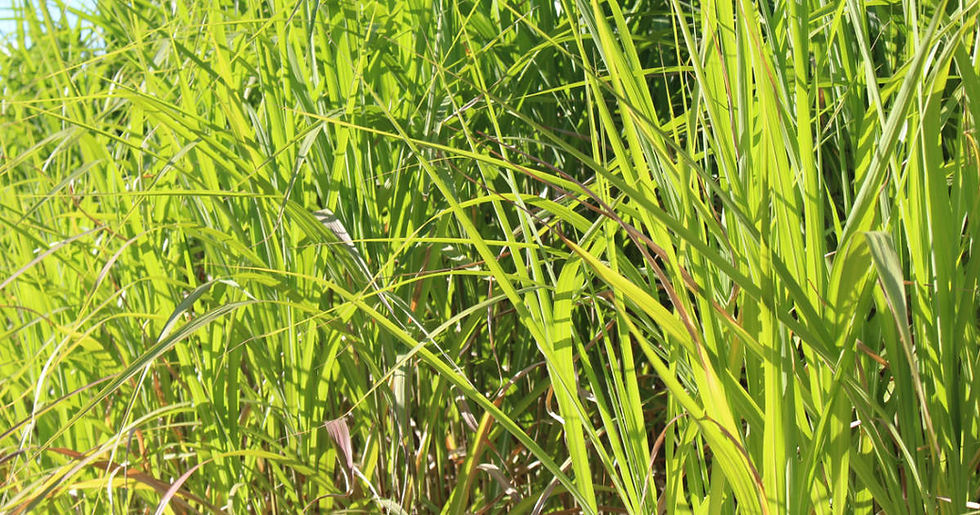
How Much Heat and Energy a Hectare of Miscanthus Biomass Produces
Updated: Sep 17
The word “biomass” sounds abstract on paper, but in the field it is simply dried plant matter, weighed in tonnes and sold under contract. Miscanthus is grown for it the same way wheat is grown for grain: dry matter yield is counted in tonnes per hectare.
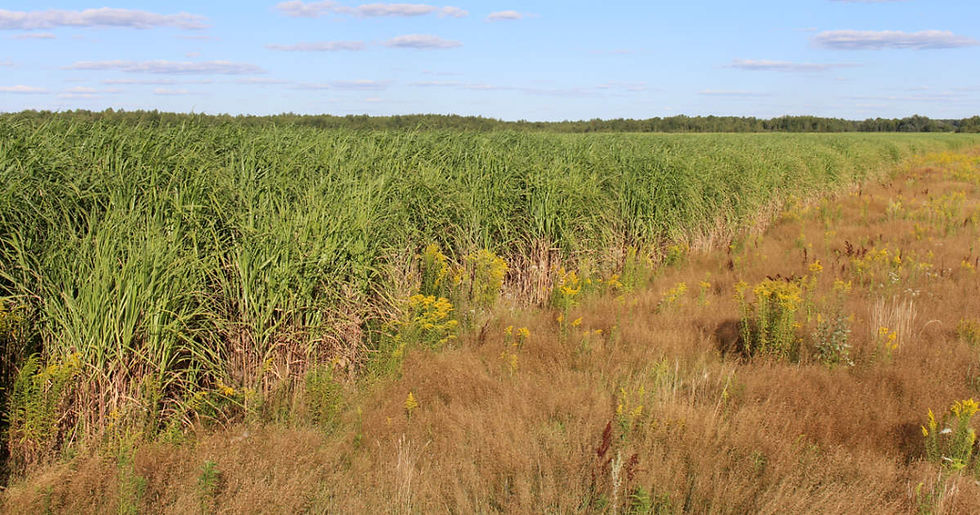
How Much Biomass a Hectare of Miscanthus Produces
The plantation reaches full working capacity from the fourth year and holds at around 20 t/ha of dry matter every year after that. One more figure matters for fuel — moisture content at harvest: in spring it runs 13–14%, so the raw material goes into processing with almost no additional drying.
Heating Value and Ash Content
According to published research, dry miscanthus biomass yields 17–20 MJ per kilogram — comparable to wood chips and higher than straw. Converted to familiar units, one tonne of dry matter replaces roughly 515 m³ of natural gas or 620 kg of coal.
Ash content depends on when the crop is harvested. In autumn the stalks still hold mineral elements that the plant moves down into the rhizome and rain washes out over winter. So spring harvesting, besides saving on drying, also gives fuel with lower ash content — less ash means less boiler maintenance and cleaner combustion.
Bales, Chips, Briquettes or Pellets
The same miscanthus biomass is processed into four forms, and each requires a different level of investment:
Form | Processing | Where it goes |
Bales | baling with a baler | large boilers and power stations that take unprocessed loads |
Chips | chipping | pellet mills, industrial furnaces |
Miscanthus briquettes | high-pressure pressing | domestic and commercial boilers |
Miscanthus pellets | grinding and die-pressing | highest density, sold to end consumers |
The deeper the processing, the more expensive the end product, but also the higher the equipment cost. For a farm just starting out, the simplest entry point is selling bales or chips to an offtaker who already runs their own pellet or briquette production.
How Britain Turned Miscanthus Into a Fuel Market
Britain's miscanthus fuel market has been running for almost ten years now and has already been through a real stress test. Terravesta supplies miscanthus biomass to two power stations in the UK, Snetterton and Brigg, under long-term contracts — 15 and 14 years respectively, roughly 25,000 tonnes of bales a year to each. According to the company, these supplies power electricity for around 82,000 homes, and the biomass itself is RED II certified.
The market also went through a policy test. In 2016 Britain's largest power station, Drax, ended direct contracts with farmers after a change in renewable energy support. Contracts covering more than 70 farms were taken over by Terravesta — and the market did not collapse, it redistributed into long-term agreements with two other stations. The lesson is simple: a fuel market for an energy crop doesn't rest on one buyer, it rests on long-term contracts with a processor.
The Ukrainian Context
Since 2026 Ukraine has run a green tariff for biomass and biogas above UAH 6 per kilowatt-hour for small electricity producers — higher than for solar or wind. For comparison, the fixed household electricity tariff the same year is UAH 4.32/kWh. On-site generation from biomass already has a working economic mechanism, not just pilot-project status.
A first project like this is already running in Ukraine. In the Teofipil community in Khmelnytskyi region, 160,000 Miscanthus × giganteus rhizomes were planted on eight hectares last year the country's first municipal miscanthus plantation, set up to clean up a site next to a wastewater treatment plant. A second phase, running 2026–2027, expands the planting to 24 hectares and adds a pellet-press die: the fuel will heat municipal buildings in the community. The project is funded by the Embassy of Slovenia in Ukraine under the Slovenia Aid & Partnership programme.
For communities this is also a matter of independence from imported fuel: the raw material grows nearby, instead of being imported as gas or coal at a rate that changes every month.
What to Do With Your Own Biomass
• Sell bales or chips to an offtaker the smallest investment, the fastest start.
• Produce your own miscanthus pellets or briquettes higher margin, but it requires equipment and a sales market.
• Use it for your own heating when the goal isn't sale but replacing gas or coal at your own site.
We support the whole chain, from planting the plantation to calculating the harvest's heating value that's a question better checked with an agronomist than guessed at.
Frequently Asked Questions
How much does equipment for miscanthus pellets cost?
The cost of a line depends on its capacity and whether additional drying is needed. This is a separate investment calculation, which we prepare as part of the plantation feasibility study.
Can miscanthus be burned in an ordinary wood-fired boiler?
You need a boiler designed for straw- or grass-type fuel. Briquettes, with a density close to firewood, fit a wider range of boilers.
Why is miscanthus a better fuel than wood chips?
A harvest every year, not once every 20–30 years like a forest. The heating value is comparable, and the logistics are simpler: a field next to the boiler house, not a forest hundreds of kilometres away.
Can miscanthus biomass be co-fired with wood chips or straw in the same boiler?
Yes, co-firing is common practice. Britain's largest power station ran for years on a mix of wood biomass, straw and miscanthus in one fuel balance, adjusting proportions to whatever feedstock was available.
Let's calculate the fuel potential of your plot — area, product form and the approximate volume per hectare.